
UV LEDs...The game-changer you shouldn't ignore!
TRADITIONAL UV LIGHT SOURCES
ARC LAMPS
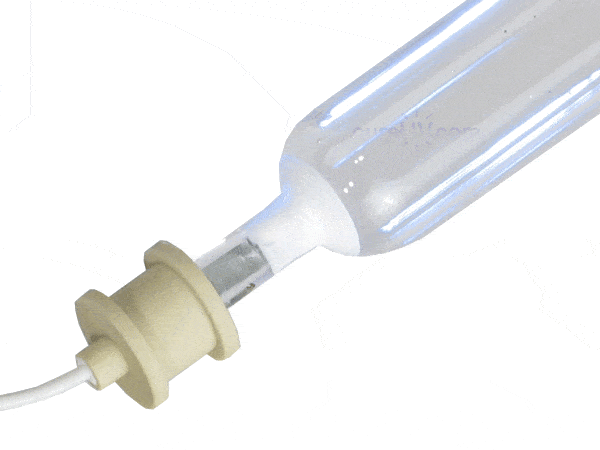
UV light sources have been around for decades. Sometimes referred to as mercury lamps, or medium pressure mercury vapor lamps. Mix argon (an easily ionized gas) with a small amount of mercury in a quartz tube and you can produce UV light. Arc lamps strike an arc across tungsten filaments at each end of the bulb which heats up the argon gas which in turn heats us the mercury to the point where it boils and eventually vaporizes and combines with the argon gas to create a gas plasma. The gas plasma radiates UV light and visible light. The quartz tube also gets hot and produces radiant Infra Red.
MICROWAVE LAMPS
A bulb with similar components to the above described arc lamp can be made with no filaments or high voltage connections, (the electrodeless lamp) and instead excites this gas plasma using microwave energy. Big advantages of these lamps are quick start and stop, no filaments, so no output loss over time, very long bulb life, and the ability to combine different fills in the bulb to tailor the spectral output of the lamp to the chemistry being cured.

UV LED LIGHT SOURCES
LED's or "light emitting diodes" were developed many years ago, but only within the last 20 or so years developed with high enough outputs in the UV spectrum to be useful in UV curing applications. LED's have become the standard product choice in several markets such as digital printing. UV LED's are virtually instant on/off light sources, exhibit extremely long life, produce less heat to the material being cured. They also use far less energy to power them and as a result are considered more environmentally friendly. UV LEDs require no external blowers for cooling adding to their energy efficiency, but sometimes do need water cooling for very high powered systems.

IN SUMMARY:
If all things were equal when considering a UV light source, those familiar with these systems would almost always choose UV LED's because of the advantages mentioned above. For many applications however, all things are NOT equal. Arc lamps and Microwave powered lamps are referred to as "broad spectrum" light sources, meaning they produce a full range of UV light within the electromagnetic spectrum. UV LEDs are referred to as "mono-chromatic" light sources, meaning the produce a single wavelength of UV light. If the material you are curing is compatible (fully polymerizes or cures) under that single LED wavelength, you are "in business"! However, many UV curable materials need long wavelength UV to penetrate through chemistry components such as pigments, and also need shorter wavelengths in order to obtain a good "surface" cure. (eliminate tackiness at the surface) In those cases, a broad spectrum light source may be the best choice.
When you are developing a UV cure process, ask your chemistry supplier if the material they're supplying you is compatible with UV LED's, then test the cure of your materials under as close to actual production conditions as possible to be sure your
equipment choice is the right one.
Talk to the experts at TTG to learn if your process is a good fit for UV LED, and test it on site with our demo equipment!


Comments